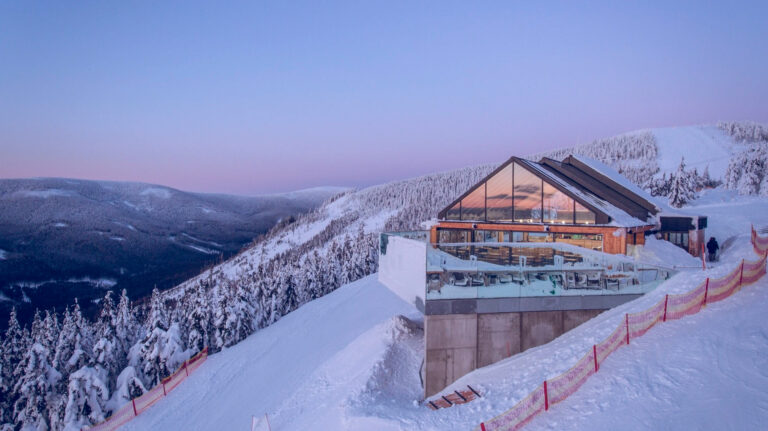
Restaurant Skalka
- Country CZ, Dolní Morava
- LOXONE partner Evora Smart s.r.o.
Challenge
The panoramic restaurant Skalka in Dolní Morava is a building with high demands on visitor comfort as well as operational efficiency. Heating, ventilation, cooling, refrigeration and freezer units and other technologies need to run reliably during operation, yet there's no reason for them to consume full power when the restaurant is empty.
The challenge was therefore to set up the individual technologies so they would automatically adapt to the building's current use. At the same time, it was necessary to gain better insight into energy consumption and the condition of individual devices, and to detect potential problems early, before they lead to a failure or damage.
The goal was to create a system that combines guest comfort, energy efficiency and simple building management in a single solution.
The challenge was therefore to set up the individual technologies so they would automatically adapt to the building's current use. At the same time, it was necessary to gain better insight into energy consumption and the condition of individual devices, and to detect potential problems early, before they lead to a failure or damage.
The goal was to create a system that combines guest comfort, energy efficiency and simple building management in a single solution.
Solution
The solution was the LOXONE system, which centralizes control of the restaurant's key technologies.
It's built around two operating modes – operating mode and non-use mode. When the restaurant is in operation, the system ensures comfortable conditions for guests. As soon as the building stops being used, the technologies automatically switch to standby and reduce their consumption.
Ventilation runs according to actual need, and heating adapts to whether the building is in use. This means there's no need to maintain full comfort mode when no one is in the restaurant.
The solution also includes online energy consumption monitoring. This gives the operator an up-to-date overview of energy management and helps identify where further optimization is possible.
LOXONE also monitors the technical condition of individual devices and helps prevent failures. Special attention is paid to the refrigeration and freezer units, where the system tracks both temperature and door status. If a door is left ajar, for example, the problem can be detected before stored stock is spoiled.
Smart control isn't limited to the technical backbone alone. The motorized glass roof allows natural ventilation to be used in summer months, reducing the need for active cooling.
The results also showed up directly in consumption. In non-use mode, energy consumption dropped by roughly half. At the same time, the building can be prepared in advance for the return to operating mode, ensuring the required conditions are in place when guests arrive.
Centralized oversight also significantly simplifies building management. The operator has the data they need in one place, and any necessary service can respond faster thanks to available information on the current state of the technologies.
It's built around two operating modes – operating mode and non-use mode. When the restaurant is in operation, the system ensures comfortable conditions for guests. As soon as the building stops being used, the technologies automatically switch to standby and reduce their consumption.
Ventilation runs according to actual need, and heating adapts to whether the building is in use. This means there's no need to maintain full comfort mode when no one is in the restaurant.
The solution also includes online energy consumption monitoring. This gives the operator an up-to-date overview of energy management and helps identify where further optimization is possible.
LOXONE also monitors the technical condition of individual devices and helps prevent failures. Special attention is paid to the refrigeration and freezer units, where the system tracks both temperature and door status. If a door is left ajar, for example, the problem can be detected before stored stock is spoiled.
Smart control isn't limited to the technical backbone alone. The motorized glass roof allows natural ventilation to be used in summer months, reducing the need for active cooling.
The results also showed up directly in consumption. In non-use mode, energy consumption dropped by roughly half. At the same time, the building can be prepared in advance for the return to operating mode, ensuring the required conditions are in place when guests arrive.
Centralized oversight also significantly simplifies building management. The operator has the data they need in one place, and any necessary service can respond faster thanks to available information on the current state of the technologies.
We didn't just want to automate individual technologies. The goal was for the whole building to respond on its own to whether it's actually being used, and adjust its consumption accordingly. The result is significantly more efficient operation, simpler management, and comfort for guests that's fully preserved.
Filip Kubín