Hydropower plant turns green
- Country AT, Weyregg am Attersee
- Build year 1981
- Area 0 m²
- LOXONE partner s2 - seidl solutions
Challenge
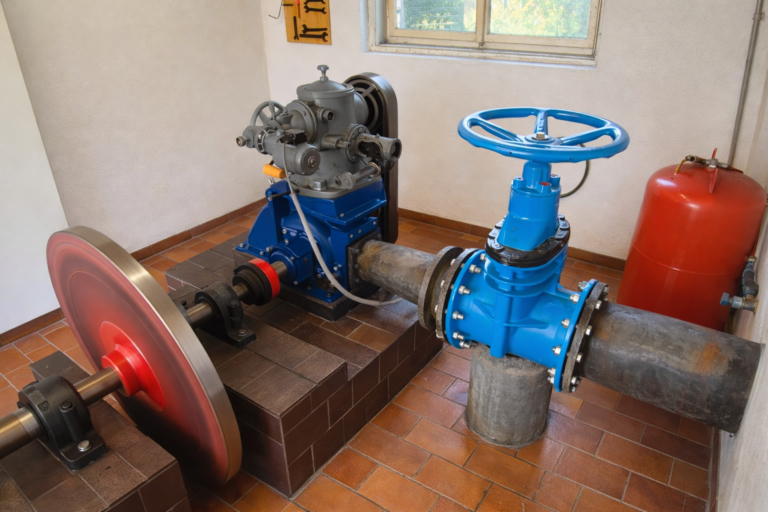
The customer has been operating a small hydropower plant with a capacity of approximately 40 kW since 1981. The plant is fed by a reservoir located about 500 m away and roughly 65 m higher than the surrounding area.
Until the modernization, the power plant was operated entirely manually and analogously. The turbine gates were adjusted manually several times a day. To assess the current operating situation (e.g., insufficient water level, imminent overflow), it was frequently necessary to check the difficult-to-access reservoir directly on site.
This regularly resulted in situations where insufficient water was available. In these cases, the generator was converted into a motor due to grid adjustments, meaning that instead of generating electricity, it drew power from the grid – incurring additional costs.
Furthermore, it was virtually impossible to optimally adjust the turbine gates to the current water level and the feed-in. This led to additional efficiency and energy losses during operation.
It was crucial to be able to continue operating the power plant components, which were in excellent condition.
Until the modernization, the power plant was operated entirely manually and analogously. The turbine gates were adjusted manually several times a day. To assess the current operating situation (e.g., insufficient water level, imminent overflow), it was frequently necessary to check the difficult-to-access reservoir directly on site.
This regularly resulted in situations where insufficient water was available. In these cases, the generator was converted into a motor due to grid adjustments, meaning that instead of generating electricity, it drew power from the grid – incurring additional costs.
Furthermore, it was virtually impossible to optimally adjust the turbine gates to the current water level and the feed-in. This led to additional efficiency and energy losses during operation.
It was crucial to be able to continue operating the power plant components, which were in excellent condition.
Solution
The core of the solution is the Miniserver, which serves as the central control unit for the entire system. By integrating relevant measurements from energy meters, as well as pressure, level, and angle sensors, the existing power plant could be fully automated – without replacing any of the central mechanical or electrical components.
A LoRaWAN-based solution was also integrated for the water storage tank. A level sensor with a self-contained, PV-powered transmitter captures the measurements and reliably transmits them to the Miniserver. This ensures continuous and location-independent monitoring of the water storage tank.
A LoRaWAN-based solution was also integrated for the water storage tank. A level sensor with a self-contained, PV-powered transmitter captures the measurements and reliably transmits them to the Miniserver. This ensures continuous and location-independent monitoring of the water storage tank.
By using Loxone technology in combination with our technical expertise, the power plant was not only fully automated, but a particularly efficient and intelligent energy management system was also implemented.<br /><br /> <br /><br /> Furthermore, the operator experiences a significant reduction in workload during daily operations and gains valuable time, as manual interventions and inspections are eliminated, and the system automatically informs or alerts the operator when necessary.
Patrick Seidl
Products
- Miniserver · 100335
- Modbus Extension · 100124
- Energy Meter 3-Phase Tree · 100567
- Energy Meter for 1&5A Current Transformers Tree · 100652