LOXONE or KNX
A fact-based comparison.
Find out how these two building automation systems differ in terms of installation, integration, scalability and maintenance.
Get to know LOXONE
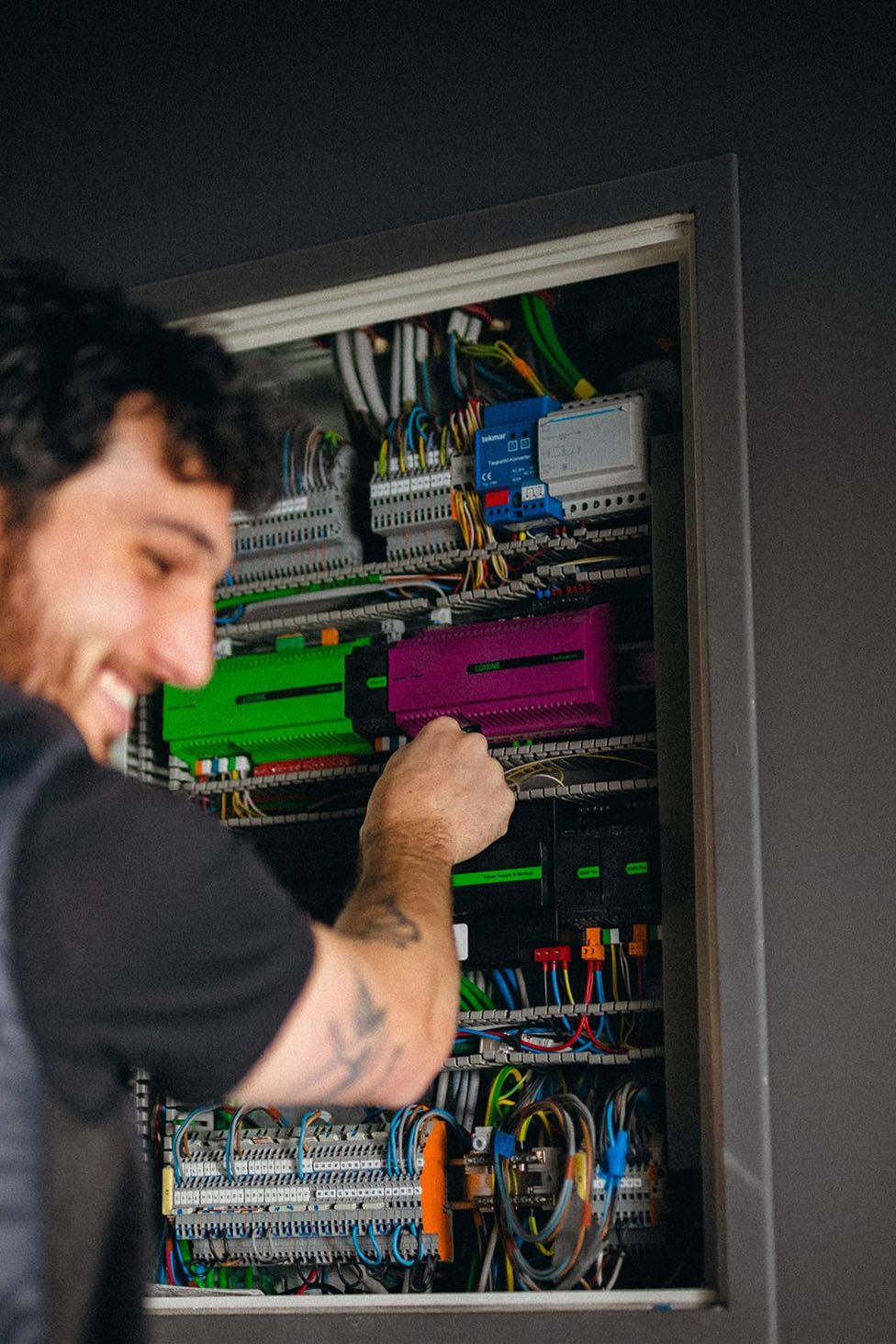
More Than Just a KNX Alternative
KNX is an established standard in building automation. Various manufacturers supply individual components that can be combined with one another.
LOXONE takes a different approach: a system that integrates hardware and software – for a seamless solution, from planning to implementation.
Openness
LOXONE
LOXONE offers numerous interfaces for integrating common standards such as KNX, DALI, Modbus, EnOcean and DMX.
In addition, there are certified connections to systems such as Apple HomeKit, Belimo and Bosch.
This allows LOXONE to be flexibly integrated into existing system environments – while maintaining centralized system logic.
KNX
KNX is an open standard that allows components from different manufacturers to be combined.
While this wide selection enables flexible system configurations, it also increases the effort required for integration and coordination during the project.
Scalability
LOXONE
LOXONE systems are fully scalable – from single-family homes to complex commercial projects.
Using the client-gateway architecture, multiple Miniserver can be networked and operated across multiple locations.
KNX
KNX systems are fundamentally scalable, but as project size increases, they require additional infrastructure (e.g., power supplies, line couplers).
This results in increased planning and installation costs.
Intelligence
LOXONE
The Miniserver is the central component of LOXONE home and building automation. It handles all control and automation features.
KNX
The intelligence of a KNX system is distributed across the sensors and actuators.
Software & Costs
LOXONE
All software, including apps, updates and remote access, is available royalty-free. There are no ongoing software costs.
KNX
The ETS software, which requires a license, is required for project planning.
Additional tools and updates may incur further costs.
Configuration & Visualization
LOXONE
Setup is quick and streamlined using LOXONE Config.
Preconfigured function blocks and Auto Config facilitate implementation.
The visualization is generated automatically and is available at no additional cost.
KNX
Project configuration is performed via the ETS and requires manual parameterization.
The use of different manufacturers and components increases the effort required for coordination.
Visualization requires additional programming effort. It also requires additional hardware, which incurs additional costs.
Support & Maintenance
LOXONE
Hardware and software come from a single source.
This reduces the number of interfaces and simplifies support and maintenance.
Centralized logic and automatic updates ensure stable operation.
KNX
Because multiple vendors are involved, support and service processes vary.
In practice, this can lead to greater coordination efforts and longer response times.
Openness
LOXONE
LOXONE offers numerous interfaces for integrating common standards such as KNX, DALI, Modbus, EnOcean and DMX.
In addition, there are certified connections to systems such as Apple HomeKit, Belimo and Bosch.
This allows LOXONE to be flexibly integrated into existing system environments – while maintaining centralized system logic.
KNX
KNX is an open standard that allows components from different manufacturers to be combined.
While this wide selection enables flexible system configurations, it also increases the effort required for integration and coordination during the project.
Scalability
LOXONE
LOXONE systems are fully scalable – from single-family homes to complex commercial projects.
Using the client-gateway architecture, multiple Miniserver can be networked and operated across multiple locations.
KNX
KNX systems are fundamentally scalable, but as project size increases, they require additional infrastructure (e.g., power supplies, line couplers).
This results in increased planning and installation costs.
Intelligence
LOXONE
The Miniserver is the central component of LOXONE home and building automation. It handles all control and automation features.
KNX
The intelligence of a KNX system is distributed across the sensors and actuators.
Software & Costs
LOXONE
All software, including apps, updates and remote access, is available royalty-free. There are no ongoing software costs.
KNX
The ETS software, which requires a license, is required for project planning.
Additional tools and updates may incur further costs.
Configuration & Visualization
LOXONE
Setup is quick and streamlined using LOXONE Config.
Preconfigured function blocks and Auto Config facilitate implementation.
The visualization is generated automatically and is available at no additional cost.
KNX
Project configuration is performed via the ETS and requires manual parameterization.
The use of different manufacturers and components increases the effort required for coordination.
Visualization requires additional programming effort. It also requires additional hardware, which incurs additional costs.
Support & Maintenance
LOXONE
Hardware and software come from a single source.
This reduces the number of interfaces and simplifies support and maintenance.
Centralized logic and automatic updates ensure stable operation.
KNX
Because multiple vendors are involved, support and service processes vary.
In practice, this can lead to greater coordination efforts and longer response times.
Introduction to LOXONE
This webinar gives you a clear introduction to the world of LOXONE. You don’t need any prior knowledge and participation is completely free.

Introduction to LOXONE’s hardware and software
Introduction to the LOXONE standards
How and why LOXONE differs from other systems
Preview of LOXONE Config
Configuration & planning of LOXONE in real life
Sign up for free now

Access Our Free On-Demand Webinar Introduction to LOXONE
Discover how to enhance your electrical installations with LOXONE’s professional automation solutions. Fill out the form to gain access to the webinar and start exploring the possibilities.
Good to Know
The first one remains empty if 1. FAQs is closed.
Your content goes here. Edit or remove this text inline or in the module Content settings. You can also style every aspect of this content in the module Design settings and even apply custom CSS to this text in the module Advanced settings.
Can LOXONE and KNX be combined?
Yes– thanks to LOXONE’s flexibility, you can combine the benefits of both solutions.
With over 250 pre-built function blocks, you can quickly and easily implement complex logic – and your personal project consultant is here to help if you have any questions!
What does the LOXONE functional warranty stand for?
In developing LOXONE Tree and LOXONE Air, we had a clear goal in mind: to minimize the installation effort in residential and commercial properties. The big advantage: everything is easily configured via Plug&Play and works together seamlessly. It just works. We are so confident in this that we offer our partners within the LOXONE system a performance guarantee.
What happens if the Miniserver fails?
Our products and software tools are designed to perform reliably in continuous 24-hour operation throughout the entire lifetime of a building.
The Miniserver is the central control unit of every LOXONE installation. We have therefore paid particular attention to its reliability. The Miniserver has no moving parts, such as fans. In addition, it is extremely energy-efficient, which means that heat generation is not a problem anyway. A failure of the Miniserver is therefore extremely unlikely.
If individual sensors or actuators do fail unexpectedly, this has no effect on the rest of the system.
A LOXONE installation can operate entirely without an internet connection if desired. Only individual services, such as remote access via LOXONE App, are then unavailable. An internet failure therefore has no effect on the functionality of a LOXONE installation.
How secure is LOXONE?
Access to smart home solutions that are operated via the cloud is often gained by logging in to the manufacturer’s website. This login can become a central point of attack. In the LOXONE system, there is no central node or external point of attack that can be hacked, as login to the Miniserver is done exclusively via the Miniserver itself – and this is located at the customer’s home and does not require an internet connection to perform its tasks.
Every LOXONE system is protected by the Miniserver’s security mechanisms, ongoing security updates, and general network security (in the hands of the user).
What if LOXONE no longer exists?
LOXONE ist ein kerngesundes globales Unternehmen, welches zudem zu den am weltweit schnellsten wachsenden Unternehmen der Branche zählt. Hier einige Daten & Fakten:
- 2009 gegründet
- Mehr als 1.200 Mitarbeitende
- 45+ Standorte weltweit
- Mehr als 300.000 realisierte Projekte in mehr als 100 Ländern
- 30.000 LOXONE Partner:innen
Ein eindrucksvoller Beweis unseres wirtschaftlichen Erfolgs ist der LOXONE Campus. 300 Arbeitsplätze, 70 Mio. Euro Investitionsvolumen und 8 Hektar Fläche sind nur einige Zahlen, die dieses einzigartige Projekt aus Büro, Hotel, Schulungs- sowie Logistikzentrum in aller Kürze beschreiben.
BSH (Bosch-Siemens-Haushaltsgeräte), Schüco, Griesser, Fronius, Viessmann und viele weitere zahlreiche starke Kooperationen stützen zusätzlich unsere Marktposition. Alle Kooperationspartner entdecken >>
LOXONE is a healthy global company that is also one of the fastest growing companies in the industry worldwide. Here are some facts and figures:
- Founded in 2009
- More than 1,200 employees
- 45+ locations worldwide
- More than 300,000 projects completed in more than 100 countries
- 30,000 LOXONE Partners
The LOXONE Campus stands as a striking evidence of our economic success. With 300 workstations, a total investment of 70 million euros, and a total area of 8 hectares, these are just a few of the figures that briefly describe this unique project, which combines an office, hotel, training center and logistics center.
BSH (Bosch-Siemens Home Appliances), Schüco, Griesser, Fronius, Viessmann and many other strong industry partners further support our market position. Discover all our partners >>
How is the LOXONE Partner Program structured?
Our partner program is built on transparency and fairness. Assigning one of four possible partner statuses allows us to treat all LOXONE Partners equally and offer transparent discounts and terms.
Depending on your partner status, the LOXONE Partner Program offers numerous benefits: from purchase discounts and ticket and phone support to listing in the partner directory.
Is there territorial protection?
No, at LOXONE there is no territorial protection.