Greenhouse control
- Country CZ
- Build year 2025
- LOXONE partner Daniel Brabec
Challenge
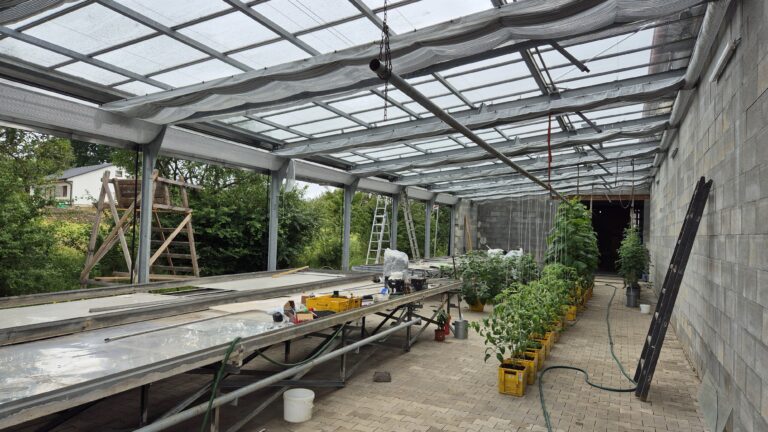
A customer contacted me with a request that he needed smart control for his greenhouse. This was implemented by a company that itself did not have a control system that would be sufficient for the customer.
Solution
The greenhouse itself consists of several shading and ventilation elements, which are equipped with conventional 3-phase motors and end-break contacts (which are not connected to the motors).
So it was first necessary to invent the motor control itself. We used a combination of conventional control in the form of contactors reversing the phase sequence for the motors. And blocking the contactors via end contacts. We took care of any possible simultaneous operation in both directions (with the resulting phase short circuit) by connecting the contactors directly to be sure.
For simplicity, we used contactors with a 24V coil. Thanks to this, we could easily introduce the state of the end contacts directly to the Loxone digital inputs.
We solved the physical quantities (such as temperature, humidity, rain, sunlight) with third-party sensors via Modbus RTU communication. Given the number and variety of sensors, it did not make sense to use the Loxone Weather Station in this case.
The biggest challenge ultimately turned out to be the form of visualization of the shading elements. The logical first choice was the Loxone Automatic Shading block. The problem turned out to be that this block cannot work with information about the end position. Which is a bit of a problem mainly because some of the greenhouse elements tend to get stuck mechanically. That's why we have solved it with the Garage Door block for now. Visually, it's not exactly ideal. But it provides the necessary functionality.
We are still working out the whole system.
So it was first necessary to invent the motor control itself. We used a combination of conventional control in the form of contactors reversing the phase sequence for the motors. And blocking the contactors via end contacts. We took care of any possible simultaneous operation in both directions (with the resulting phase short circuit) by connecting the contactors directly to be sure.
For simplicity, we used contactors with a 24V coil. Thanks to this, we could easily introduce the state of the end contacts directly to the Loxone digital inputs.
We solved the physical quantities (such as temperature, humidity, rain, sunlight) with third-party sensors via Modbus RTU communication. Given the number and variety of sensors, it did not make sense to use the Loxone Weather Station in this case.
The biggest challenge ultimately turned out to be the form of visualization of the shading elements. The logical first choice was the Loxone Automatic Shading block. The problem turned out to be that this block cannot work with information about the end position. Which is a bit of a problem mainly because some of the greenhouse elements tend to get stuck mechanically. That's why we have solved it with the Garage Door block for now. Visually, it's not exactly ideal. But it provides the necessary functionality.
We are still working out the whole system.