Answering the Future Buildings Standard.
To meet the Future Buildings Standard, efficient building fabric and low-carbon technologies are only part of the solution. Intelligent building control brings heating, cooling, ventilation, lighting, shading and energy systems together, helping the building operate efficiently in the real world – not just perform on paper.
Clearing up the Future Buildings Standard – FAQs:
The first one remains empty if 1. FAQs is closed.
Your content goes here. Edit or remove this text inline or in the module Content settings. You can also style every aspect of this content in the module Design settings and even apply custom CSS to this text in the module Advanced settings.
What is the Future Buildings Standard?
The Future Buildings Standard is the new energy-performance standard for new non-domestic buildings in England.
Its objective is to create highly energy-efficient, low-carbon buildings that will not require major energy-related retrofit to become zero-carbon in operation as the electricity grid decarbonises.
The government’s notional building specification incorporates measures including improved fabric performance, low-carbon heating, improved lighting efficiency, heat recovery and solar PV for many building types.
The challenge is making all of those technologies work efficiently together.
When does the Future Buildings Standard come into effect?
The Future Buildings Standard comes into force in England on the 24th March 2027, introducing higher energy-efficiency requirements for new non-domestic buildings. Transitional arrangements will apply to projects already underway, with separate arrangements for higher-risk buildings.
To meet the new standard, buildings will typically need a combination of high-performance building fabric, low-carbon heating such as heat pumps or heat networks, more efficient lighting, heat recovery and, for most building types, solar PV. The updated guidance also places increased emphasis on the efficiency, commissioning and control of fixed building services.
The challenge is that these technologies cannot deliver their full potential if they operate independently. A unifying building automation platform, such as LOXONE, can bring heating, cooling, ventilation, lighting, shading, PV and energy management together, allowing the building to respond intelligently to occupancy, demand and available energy rather than relying on a collection of standalone controls.
Who does the Future Buildings Standard affect?
The standard is relevant across new non-domestic and mixed-use developments, including:
Hotels
Control energy around actual room occupancy while maintaining the guest experience.
Student Accommodation
Manage hundreds or thousands of rooms intelligently while giving operators visibility across the development.
Offices
Coordinate HVAC, lighting, shading and occupancy to avoid conditioning or illuminating empty space.
Care Homes
Combine comfort, safety, energy management and building services within one adaptable control platform.
Mixed-Use Developments
Bring multiple building functions and energy demands together rather than creating separate control silos.
And beyond
Education, retail, leisure, hospitality, industrial and other non-domestic buildings all face the same fundamental question:
How do you make increasingly complex building services work as one efficient building?
What is the challenge faced for developers?
The challenge is no longer simply designing an efficient building. Developers must deliver high levels of energy efficiency, low-carbon heating and, in most cases, solar PV, while balancing build cost, programme, specification complexity and the long-term operation of the building.
As more technologies are added, the risk is creating a collection of standalone systems that each operate independently. Heating, cooling, ventilation, lighting, shading and renewable energy may all be efficient in isolation, but the building performs best when they work together.
A unifying controls platform, such as LOXONE, can coordinate these technologies, helping developers simplify the controls strategy while improving how the completed building responds to occupancy, demand and available energy.
What technology will typically be required to meet the Future Buildings Standard?
The Future Buildings Standard does not prescribe one fixed technology package for every project. Instead, buildings must achieve the required performance against a notional building specification.
That reference specification includes high-performance building fabric, low-carbon heating such as heat pumps, more efficient lighting, enhanced heat recovery and solar PV equivalent to 40% of the building’s foundation area for most building types.
As more low-carbon technologies are introduced, how they are controlled becomes increasingly important. Heating, cooling, ventilation, lighting and solar can all operate efficiently individually, but a unified automation platform, such as LOXONE, allows them to share information and work together – helping the finished building use energy more intelligently in day-to-day operation.
Does the Future Buildings Standard require a BMS?
The Future Buildings Standard does not explicitly require a BMS, but as buildings combine low-carbon heating, solar PV and increasingly efficient building services, a unified control strategy becomes increasingly valuable. This is where LOXONE comes in.
Why a unifying BMS is needed?
The Future Buildings Standard will bring more low-carbon heating, solar PV and energy-efficient building services into new non-domestic buildings.
The challenge is making sure these technologies do not operate as separate, isolated systems. Heating, cooling, ventilation, lighting, shading and renewable energy all influence how much energy a building ultimately uses.
A unifying BMS brings these services together, allowing them to share data and respond intelligently to factors such as occupancy, temperature, daylight and available renewable energy.
With a platform such as LOXONE, this means the building can be controlled as one complete system – helping reduce unnecessary energy use, simplify operation and close the gap between modelled performance and how the building actually performs once occupied.
How do you ensure the building performs as designed after handover?
It opens the door to metering, monitoring, trend data, identifying inefficient operation, comparing actual performance against expectations and ongoing optimisation. This is exactly what LOXONE’s Exosphere is made for.
Can existing building technologies be integrated into one BMS?
Yes. Developers do not necessarily need to replace technologies that have already been specified.
A unifying BMS, such as LOXONE, can integrate with existing systems including heating, cooling, ventilation, lighting, solar, energy metering and other building services, using established interfaces such as BACnet, Modbus, DALI and EEBUS.
This allows LOXONE to act as the intelligent control layer, bringing otherwise separate systems together so they can share data and respond as one building.
The result is a more coordinated controls strategy, less duplication and a building that can be monitored and optimised as a whole.
Can developers use their existing contractors to install for the Future Buildings Standard?
Yes. Developers can continue to use their existing M&E contractors, electricians, heating engineers and ventilation specialists to install the technologies required for the Future Buildings Standard, provided the work meets the relevant Building Regulations, design and commissioning requirements.
With LOXONE, those existing contractors can work alongside a LOXONE Partner who can support the panel build, programming and commissioning. The electrical contractor can then install to a clearly defined wiring schedule, allowing the existing project team to remain involved without introducing multiple separate controls specialists.
This creates one unified automation platform connecting HVAC, lighting, shading, energy and other building technologies, rather than relying on several standalone control systems.
For developers, the result is a repeatable controls strategy across multiple projects, simpler installation and handover, and greater consistency in how buildings are operated and optimised over the long term.
Will the Future Buildings Standard increase construction costs?
Potentially, yes. Higher-performing building fabric, low-carbon heating, solar PV and more sophisticated building services can increase upfront capital costs.
However, a well-designed controls strategy can help offset some of that investment. Using one unified BMS, such as LOXONE, can reduce duplication between separate control systems while providing the infrastructure for energy management, monitoring and additional smart-building functionality.
Depending on the development model, the return can come in different ways: lower ongoing energy and operating costs for retained assets such as hotels, offices and care homes, or through value-added upgrade packages and enhanced property specification where units are being sold.
The opportunity is therefore not simply to add more technology, but to make the required technology work harder and deliver additional value.
Why LOXONE?
Open integration
Connect technologies through interfaces including BACnet, Modbus, DALI and EEBUS.
Scalable
From an individual building to portfolios with hundreds of LOXONE Miniservers through Exosphere.
One system. Total control.
Bring HVAC, lighting, shading, energy, access and other building services together.
Data-driven
Measure how the finished building actually performs.
Active Energy Management
Use energy information to automatically influence building operation.
Centralised with Exosphere
Monitor, compare, back up and optimise projects from one platform.
More than compliance
Use the same infrastructure to create a better building for the operator and the people using it.
The building passed the HEM model. But will it perform in the real world?
The Future Buildings Standard raises the bar for new non-domestic buildings in England, requiring low-carbon heating and significantly higher levels of energy efficiency.
The new regulations come into force from 24 March 2027, subject to transitional arrangements, with separate commencement arrangements for higher-risk building work.
For developers, consultants and operators, however, achieving the design calculation is only part of the challenge.
How will the finished building actually perform once people move in?
LOXONE brings heating, cooling, ventilation, lighting, shading, solar, energy monitoring and other building services together into one intelligent control platform – helping buildings respond to real occupancy, demand and energy availability rather than operating as disconnected systems.
Design it. Measure it. Optimise it.
From on paper, modelled performance to the real-world results
The Future Buildings Standard uses a performance-based approach. A proposed building is assessed against a theoretical notional building with defined energy and carbon performance.
For non-domestic buildings, assessment is based around the National Calculation Methodology (NCM), implemented through tools such as SBEM and Dynamic Simulation Models – rather than the Home Energy Model (HEM) used for dwellings.
But a model remains a model.
– Occupancy changes.
– Weather changes.
– Energy tariffs change.
– Equipment operates differently.
– Settings get altered.
– Buildings rarely behave exactly as predicted.
That is why data is king.

With LOXONE, the control system that operates the building can also provide the data needed to understand how it is performing.
Model → Measure → Compare → Optimise
MODEL
Design and assess the building against the required performance targets.
MEASURE
Monitor actual consumption, temperatures, occupancy, system operation, generation and other relevant building data.
COMPARE
Analyse expected performance against what is actually happening in the finished building.
OPTIMISE
Identify unnecessary consumption, incorrect settings or unusual behaviour and adapt the building controls accordingly.
This creates a feedback loop that continues after practical completion, rather than energy performance becoming a one-off design exercise.
The missing link: unifying control
Installing efficient technology does not automatically create an efficient building.
– A heat pump can have its own controls.
– Ventilation can have another.
– Lighting another.
– Solar another.
– EV charging another.
– Metering another.
Each may work perfectly well individually.

The opportunity comes when the building understands the relationship between them.
LOXONE acts as the intelligent layer between building technologies, allowing information from one system to influence another automatically.
– Heating and cooling can react to occupancy.
– Shading can reduce unwanted solar gain.
– Ventilation can respond to air quality and demand.
– Lighting can react to presence and daylight.
– EV charging can respond to available power.
– Flexible loads can make better use of onsite solar generation.
One building. One control strategy.
Active Energy Management
Don’t just monitor energy. Control what happens next.
Traditional energy monitoring tells you where energy has already gone.
LOXONE can go a step further.
By combining metering with building automation, energy information can directly influence how the building operates.
Generate
Integrate onsite renewable generation such as solar PV.
Measure
Understand where and when energy is being consumed.
Prioritise
Direct available energy towards the loads that matter.
Shift
Move flexible consumption to more advantageous periods where the type of building application permits.
Optimise
Automatically reduce unnecessary consumption without relying on occupants or facilities teams to continually intervene.
This turns the Energy Management System from a dashboard into an active part of the building.
One platform. More than energy.
The same infrastructure installed to intelligently control energy can provide the foundation for far more.
LOXONE supports established building technologies and protocols including BACnet, Modbus, DALI and EEBUS, allowing multiple building services to be brought into a common automation strategy.
Specify the foundation. Add the value.
For developers, this also creates another commercial opportunity.
Install the core control architecture as part of the building specification and additional functions can then be offered as upgrade packages – rather than introducing completely separate systems.

And after handover? Meet LOXONE Exosphere.
One building is useful. A portfolio is powerful.
LOXONE Exosphere provides a central, web-based platform for monitoring and managing LOXONE installations across individual buildings or entire estates.
It enables building owners, operators and facilities teams to turn operational data into actionable information.
Target vs actual
Compare target values with real measured performance.
Long-term data
Retain building statistics over years for deeper analysis.
Benchmark buildings
Compare sites directly and identify unusual consumption or configuration.
Data-driven optimisation
See where intervention is needed and measure whether the changes actually worked.
Central monitoring
View energy, climate, faults and system status across multiple locations.
Automatic backups
Secure project states centrally without relying on manual backups.
Fleet-wide updates
Roll out firmware updates across large numbers of Miniservers centrally.
Proactive maintenance
Identify outages and system issues across the portfolio before they become larger operational problems.
Exosphere supports long-term analysis, location benchmarking and target-versus-actual comparison – creating the foundation for a continuous measure, optimise, verify strategy.
Read more
Credentials
Reference Case Studies

Government department for Energy Security & Net Zero’s ETL Listing:
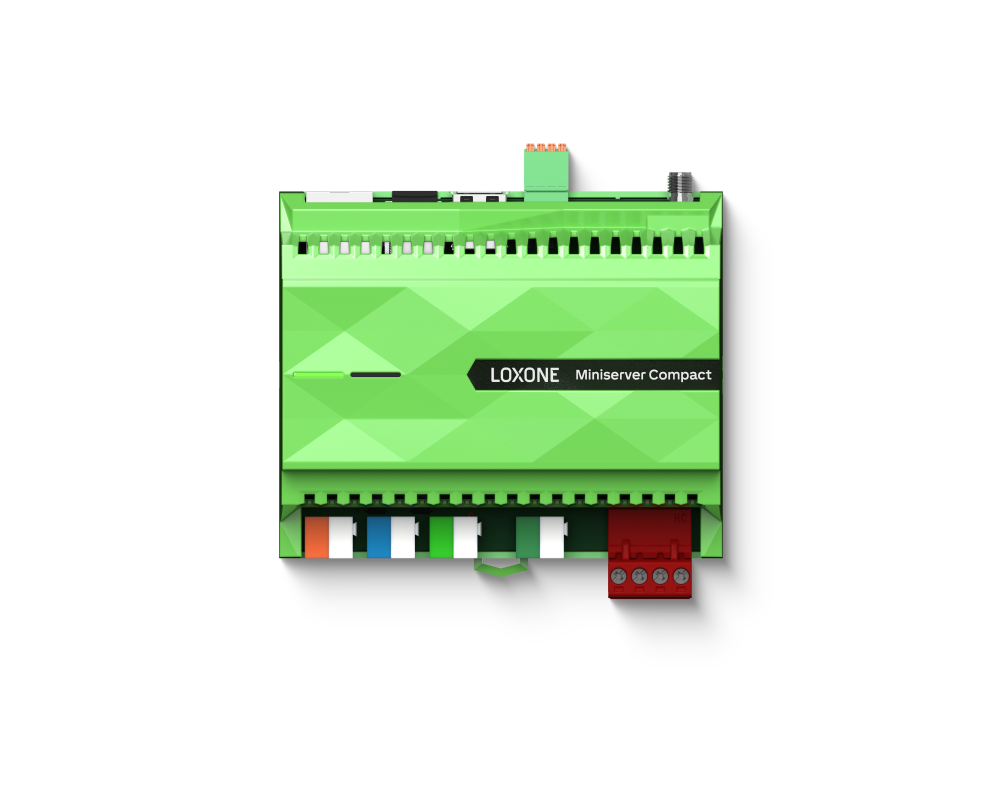
The LOXONE Miniserver, Miniserver Go and Miniserver Compact are listed on the Department for Energy Security & Net Zero’s Energy Technology List (ETL) under the Building Energy Management System category. This government-backed recognition confirms that LOXONE has met the ETL’s strict requirements for energy efficient building management systems, giving developers, housebuilders and specifiers added confidence in the reliability and performance of the technology. As the Future Homes Standard raises expectations around energy efficiency, low-carbon heating and smarter building operation, LOXONE provides one integrated platform for energy monitoring and intelligent automation – helping homes respond automatically to real conditions, reduce unnecessary energy use and support long-term performance through one unified controls platform.
Template Development: Eden’s Green
There is lots of numbers and noise around the Future Homes Standard and how it will impact developers but we cut through all of this mass of information with a live template project that we have actually done and is working in the field. Discover Eden’s Green in the video below:
Research Project: eHome2 for the Future Homes Standard
eHome2 is a collaboration between Saint-Gobain UK & Ireland and Barratt Developments. It is a three-bed detached house built inside of the University of Salford’s big climatic chamber called Energy House 2.0. The research project tested building solutions for the Future Homes Standard and accelerate those involved towards producing low-carbon and net-zero housing. LOXONE is one of the solutions that was crucial in this testing and plays a key role as the home automation system, automating all of our own devices as well as third-party ones. Plus, the LOXONE system was used by the university’s research team to conduct the actual study. Discover more about the eHome2 project in the video below:
LOXONE Partner: Zmart Hohm
Stakeholders: Saint Gobain, Barratt Developments and the University of Salford
📍 Salford, UK
If you have any questions or have a project to discuss contact us below: