Photovoltaics: make the most of solar energy
More self-consumption and lower costs with intelligent energy management.

How to get the most out of your PV system
LOXONE measures generation and consumption, decides with foresight what pays off right now—using, storing, or exporting to the grid—and controls your loads accordingly, from the heat pump to the EV.
PV system with energy management: the benefits

Your investment pays off faster
Large appliances run automatically when there’s enough of your own solar power. This lowers your electricity bill and gets more out of your system.

Surplus is put to good use
Instead of being sent back to the grid for little return, your surplus automatically goes where you need it—to devices and batteries, based on your priorities and the PV production forecast.

No overloads, no costly peaks
When several large loads run at the same time, LOXONE balances the load automatically. At home, this prevents overloads; in a business, it avoids costly demand peaks.

Your EV charges automatically with solar power
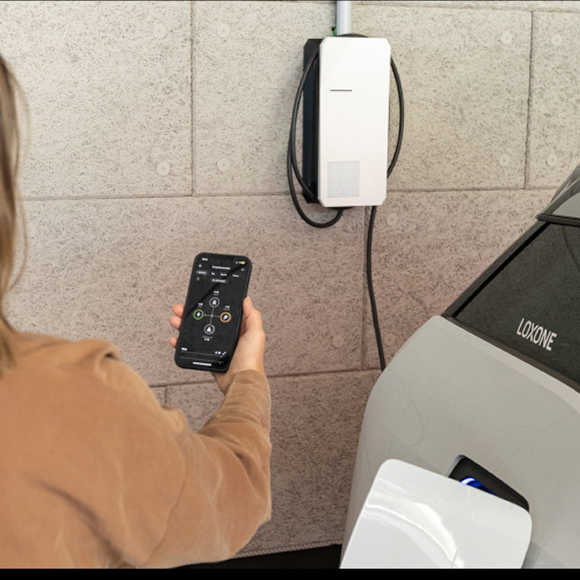
The LOXONE Wallbox charges with your PV surplus or with low-cost electricity from your dynamic utility rate. This makes driving cheaper and makes optimal use of your PV system.

Everything at a glance
In the App, you can see generation, consumption, and storage in real time and set your own priorities. You’re notified immediately of any deviations or technical problems—increasing safety and reliability.
What you need
PV energy management also works with your existing system. The Miniserver integrates common inverters, batteries, and devices—all you need are a few LOXONE components and setup by a certified LOXONE Partner.

Miniserver
The control center for your entire building: from lighting and shades to energy management.

Energy Meter and software meter blocks
Measure all energy flows in real time—the basis for any control.

Wallbox
Charges your EV specifically with your solar surplus or with low-cost electricity from your dynamic utility rate.

Modbus Extension (optional)
Only needed for devices connected via Modbus RTU. The Miniserver already connects to many inverters and meters directly via Modbus TCP.
Retrofit EV charging
Everything for charging your EV: from the controls to the Wallbox—retrofitted wirelessly, without any remodeling.

An open system for your PV technology.
Inverters and batteries from common manufacturers such as Fronius, SMA, Kostal, or Huawei are easy to integrate. You can find the complete, up-to-date list in the LOXONE Library.
FAQs
What is an energy management system for photovoltaics?
An energy management system for photovoltaics is a control system that automatically sends self-generated solar power to where it makes the most sense—instead of exporting it to the grid unused. It continuously measures how much power is generated and consumed, and switches loads such as the heat pump, water heater, or Wallbox exactly when solar power is available. This increases self-consumption and lowers your electricity bill.
Photovoltaics is only one part of it: LOXONE controls energy management throughout the building and connects it with the entire building automation.
Does it work with my existing PV system?
Which inverters is LOXONE compatible with?
With most common models. Some, such as those from Fronius, are supported directly; many others like SMA, Kostal, Huawei, or SolarEdge can be integrated via the open Modbus standard. You can see whether your model is included and how it’s connected in the LOXONE Library.
Can I charge my electric car with my PV system?
Is solar energy management worth it without a battery?
Is PV control worth it in winter, too?
Yes, even though the yield is lower. A PV system still delivers a meaningful share of its annual yield in winter, and that’s exactly when LOXONE puts every kilowatt-hour to work for heating and hot water. More on this: Photovoltaics in winter.
How does LOXONE know the weather forecast?
Via the LOXONE Weather Service and the PV production forecast: the Weather Service delivers location-specific forecast data up to 66 hours in advance directly to your Miniserver. Based on this, the PV production forecast calculates how much power your system is expected to produce over the next 72 hours. This way, the system knows when storing or using power directly pays off. The Miniserver needs an internet connection for this.
Ready to get the most out of your solar power?
Our experts will show you how to cut costs and become more independent.

Free, no obligation
Personalized solutions
First-hand expertise
Quick answers to your questions
Oops! We could not locate your form.