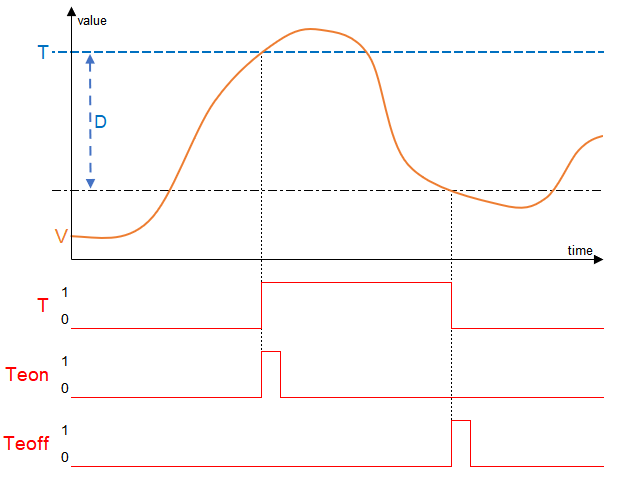
The Differential Threshold Switch analyzes an analog input value using two threshold values, and switches a digital output accordingly.
The first threshold is specified with parameter (T).
The second threshold is specified with parameter (D) as a differential value relative to parameter (T).
The functionality differs, depending on whether (D) is positive or negative.
Table of Contents
Inputs↑
| Abbreviation | Summary | Value Range |
|---|---|---|
| V | Value | ∞ |
Outputs↑
| Abbreviation | Summary | Value Range |
|---|---|---|
| T | 1 depending on the set threshold values. | 0/1 |
| Teon | Pulse on rising edge | 0/1 |
| Teoff | Pulse on falling edge | 0/1 |
Parameters↑
| Abbreviation | Summary | Description | Value Range | Default Value |
|---|---|---|---|---|
| T | Threshold | ∞ | 5 | |
| D | Difference | ∞ | 2 | |
| Rem | Remanence input | Remanence input: If active, the function block retains its previous state after a Miniserver reboot. The state of the function block is saved: – When saving to the Miniserver – At a planned reboot – Before a backup – Once per hour The data is saved on the SD card. | 0/1 | 0 |
Function↑
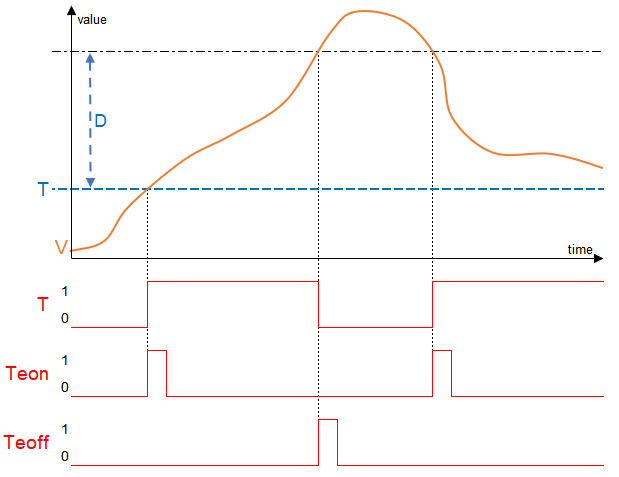
Function when differential value is positive:
The second threshold value is above parameter T (T+D).
Output (T) switches on when the input value is between the threshold values.
Example: T: 5, D: 2
The output is On when the input value is between 5 and 7.
The output remains off above and below these values:
Function when differential value is negative:
The second threshold value is below parameter T (T-D).
Output (T) is switched on when the input value exceeds parameter (T) and switched off when the input value drops below (T-D).
Example: T: 5, D: -2
When the input value exceeds 5, the output switches on. It remains on above this value.
If the input value drops below 3, the output switches off. Below that it remains off: