PV plant for research
- Country PL, Poznań
- LOXONE partner Politechnika Poznańska
Challenge
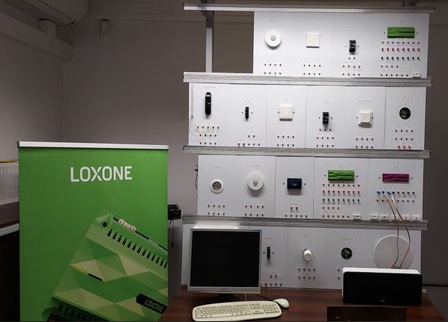
The project involves the reconstruction of the existing mock-ups of the Loxone system by adding a photovoltaic installation made according to its own design. The extended mock-up will be used for didactic and research works. It will be used during didactic classes held as part of the courses of Electrical Power Engineering, Electrical Engineering and Green Energy at the Poznań University of Technology. Research works will also be carried out, in which students associated in the Electronus Science Club will take part. One of the objectives of the project is to test the efficiency of the Loxone installation with used photovoltaic panels (long-term study). It will also be possible to carry out laboratory exercises on the cooperation of the Loxone installation with a photovoltaic installation (storage and use of the generated power).
Solution
The photovoltaic installation was made as part of the competition announced by the Recover Environment foundation for the implementation of a photovoltaic installation from recycled elements. As part of the work carried out, a foundation with a foundation earth electrode was made. The pillars supporting the structure are a remnant of the research work carried out. The structure supporting the panels was also made by myself.
The panels used are recycled. Before installation, all panels have been tested for use. Ultimately, the structure can accommodate four panels with a total power of 1440 W.
The energy produced in the panels is stored in lead-acid batteries. Used car batteries (recycled) with a total capacity of 165 Ah were used. The batteries were placed in a switchgear mounted on the wall of the building. In order to enable the modification of the stations in the section between the presented structure and the place where the batteries are placed, they are run in a PVC pipe with a diameter of 120 mm, which has been buried and concreted in the ground.
Behind the presented switchgear with batteries there is a drilling to the building. It was possible to lead the cable to the laboratory of the intelligent building (where the mock-ups are located). As a consequence, it is possible to power the constructed mock-ups. The mock-ups were constructed by KN Electronus students and as part of their diploma theses. It was possible thanks to the agreement between Loxone and the Poznań University of Technology. Link to the circle's website: https://www.facebook.com/electronus.PP
As part of further work, it is planned to replace the PWM charging regulator with an MPPT one, as well as to select protection devices and install a converter stabilizing the voltage reaching the mock-up. After connecting the mock-up to the presented installation, it is planned to store and count the produced power depending on the arrangement of the panels and irradiation. It is also planned to measure the temperature of the panels in order to relate the power produced to the temperature of the panel. It will be possible to extend laboratory classes with exercises on energy storage and cooperation of the Loxone system with photovoltaic panels. Thanks to the construction of the stands, it will be possible to present all parts of the installation. An additional mini-server will make it easier to carry out the work and will enable an increase in the number of exercises (expansion of the existing two stations to three stations).
The panels used are recycled. Before installation, all panels have been tested for use. Ultimately, the structure can accommodate four panels with a total power of 1440 W.
The energy produced in the panels is stored in lead-acid batteries. Used car batteries (recycled) with a total capacity of 165 Ah were used. The batteries were placed in a switchgear mounted on the wall of the building. In order to enable the modification of the stations in the section between the presented structure and the place where the batteries are placed, they are run in a PVC pipe with a diameter of 120 mm, which has been buried and concreted in the ground.
Behind the presented switchgear with batteries there is a drilling to the building. It was possible to lead the cable to the laboratory of the intelligent building (where the mock-ups are located). As a consequence, it is possible to power the constructed mock-ups. The mock-ups were constructed by KN Electronus students and as part of their diploma theses. It was possible thanks to the agreement between Loxone and the Poznań University of Technology. Link to the circle's website: https://www.facebook.com/electronus.PP
As part of further work, it is planned to replace the PWM charging regulator with an MPPT one, as well as to select protection devices and install a converter stabilizing the voltage reaching the mock-up. After connecting the mock-up to the presented installation, it is planned to store and count the produced power depending on the arrangement of the panels and irradiation. It is also planned to measure the temperature of the panels in order to relate the power produced to the temperature of the panel. It will be possible to extend laboratory classes with exercises on energy storage and cooperation of the Loxone system with photovoltaic panels. Thanks to the construction of the stands, it will be possible to present all parts of the installation. An additional mini-server will make it easier to carry out the work and will enable an increase in the number of exercises (expansion of the existing two stations to three stations).
We chose Loxone because it is an internationally recognized company. The signed agreement (between Loxone and Poznań University of Technology) enabled the expansion of the existing didactic base, which is one of the attractions of the newly created majors. We hope that the expansion of the existing didactic base will contribute to further joint successes.
Krzysztof Dziarski, assistant