One vs Many
Homeowners face a critical decision: should they piece together a system consisting of consumer electronics from different brands, or opt for a comprehensive, unified solution installed by an expert? This choice can significantly impact not only the performance and ease of use but also long-term savings and sustainability.
Let’s explore the key differences between both options. Which approach may be the smarter, more cost-effective option for your home?
- Security: Does your data stay at home?
- Energy efficiency: Maximize efficiency, minimize costs
- Automation and control: How many apps, buttons, manual actions…
- Installation and maintenance: Get it right from the start
- Voice control: Good or bad?
- Product choice and scalability: Freedom or harmony?
- Design: Don’t underestimate aesthetics
- Costs: What matters is the bottom line
- Conclusion
Security: Does your data stay at home?
Security today means more than protecting people and property – it also means protecting your privacy.
DIY
Many consumer devices rely on the cloud to some degree, so sensitive information – when you’re home, what your cameras see – travels to remote servers. You can’t be sure what happens to it there. It also increases the risk of cyberattacks and data breaches. And every new device from another brand is one more potential entry point, since not all of them are equally well protected.
Professional systems
Professional systems process sensitive data – presence, camera footage, alarm status – locally, not in the cloud. They use advanced encryption and security protocols built for demanding standards, and all devices run in one separate network. Adding more of them doesn’t add more risk. And with no central cloud holding data from thousands of users, they’re a far less attractive target for attackers.

Energy efficiency: Maximize efficiency, minimize costs
How a smart home manages energy affects both your comfort and your long-term savings.
DIY
Smart thermostats and plugs offer basic energy management, one device at a time. They can’t coordinate the whole home – so unless they’re connected, the air conditioner may start cooling while the heater is still heating. Even the savings from smart bulbs are questionable, as staying connected costs energy too. Smart EV chargers look promising, but they only pay off when they’re connected to your solar panels and household consumption – so why not choose a complete solution right away?
Professional systems
Professional systems manage energy across the entire home – lighting, heating, hot water, solar panels and electric vehicle charging – as standard. They optimize consumption based on current conditions and your preferences, which reduces energy costs, often by tens of percent, and makes your home more sustainable.
Automation and control: How many apps, buttons, manual actions…
What a smart home can really do depends on whether its parts work together – and how easy it is to control them.
DIY
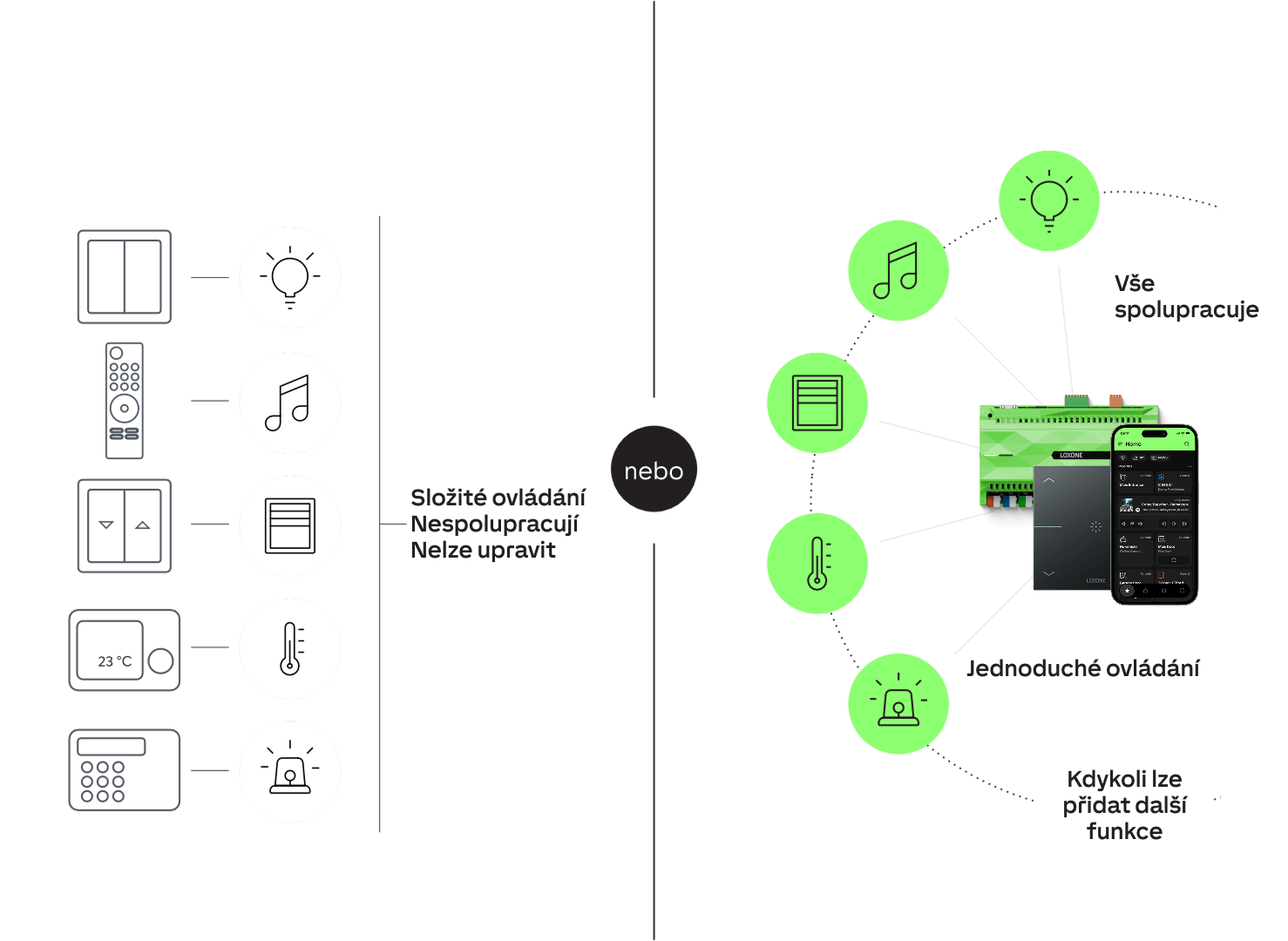
Individual gadgets often work well on their own, but rarely together. Lights, thermostats and cameras each need their own app, display or remote, and automations often need manual tweaking. Instead of one smart home, you end up with several “islands” of control – and missing advanced features limit even experienced users.
Professional systems
In a professional system, sensors, lighting, heating, shading and security work as one unit and respond intelligently to what’s happening. The system can, for example, regulate the water temperature in your heat pump and storage tank, or reduce the charging power of your electric car when household appliances need more energy, preventing an overload. Most things happen automatically. When you do want to step in, everything is in one app, and one button per room is enough – no extra remotes or thermostats on the wall.
Installation and maintenance: Get it right from the start
How a smart home is installed and looked after decides how smoothly it runs over the years.
DIY
The first devices are easy to set up yourself. With every new one, though, the risk grows that something won’t work with the rest. Each product has its own updates, its own support and usually a short life cycle, and a single update to a central hub can make some devices lose functions. When problems arise, you have to contact several providers – or buy a replacement because the original device turned out to be incompatible.
Professional systems
A professional system is installed by an expert who integrates everything into one cohesive whole and sets it up correctly from day one. No trial and error, no searching through online forums. After that, the entire system is updated and maintained as one, so its parts never fall out of sync. Support is long-term, and many issues can be solved remotely – no waiting for a service visit, no chasing several providers.
Voice control: Good or bad?
While voice control has become a popular feature, it’s important to question its real necessity in a highly automated environment. Many systems rely heavily on voice commands to operate various devices. It can feel convenient at first. However, with a well-designed automation system the need for voice commands diminishes significantly.
Automation vs. Voice Control
In a truly intelligent home, many actions are handled automatically without the need for user input. Lights adjust based on occupancy and daylight, heating adapts to the weather and your schedule, and security systems activate without requiring constant interaction. This kind of seamless automation makes voice control less essential since the system is already anticipating and responding to your needs in real-time.
Compatibility and Limitations
Voice assistants often face compatibility issues. Not all devices or systems work smoothly together across platforms. When trying to create a unified system through voice control, users may encounter problems with partial functionality, missing integrations, or delayed responses due to cloud dependencies.
Product choice and scalability: Freedom or harmony?
Your home evolves with you. The question is which products you can use today – and how easily you can add more tomorrow.
DIY
Choosing from countless gadgets feels like freedom. In reality, the choice shrinks quickly, because everything has to be compatible – different protocols, software versions, apps. With every expansion, the system gets more complicated. And since consumer devices are usually single-purpose, you keep buying new ones even where existing ones could do the job: why buy presence sensors for your alarm when your lighting sensors already detect presence?
Professional systems
A single manufacturer’s range may look narrower. Some professional systems are closed; more open ones also integrate proven third-party devices. Often, the variety is simply hidden behind interfaces: support for DALI, a widely used lighting standard, opens the door to thousands of lights from established brands. Professional products are designed to work together – even years later. You can add as many devices as you need, and they fit into the existing setup. Wired and wireless technology can be combined, which makes retrofits and extensions much easier. And because everything runs on one central control unit, new features don’t mean buying a new one – whether it’s a small apartment or a large residence.

Design: Don’t underestimate aesthetics
Clean, minimalist design is appealing – and the technology in your home has a big influence on the interior.
DIY
Devices from different brands rarely look like they belong together. Even basic black or white variants differ in shade, finish and shape, and mismatched buttons, controllers and thermostats can disrupt an otherwise harmonious space. If you want a specific color or shape to match your interior, you’re usually out of luck – consumer design follows current trends.
Professional systems
A professional system lets you get rid of rows of switches, hanging cables and mismatched displays, leaving the space visually clean and the controls unified. If you already have designer lights, switches or sockets in mind, they can usually still be integrated – designer lights, for example, can be dimmed automatically based on presence. That’s why architects and interior designers value this flexibility.
Costs: What matters is the bottom line
With a limited budget, price matters – especially at the beginning. But the real value only shows in the long run.
DIY
A smart home can start with a colored bulb for a few euros. Plug it in, and voilà – you have light controlled by an app! As more devices follow, the costs add up, with no clear picture of the total from the outset. In the end, you may pay more than a professional solution would have cost. And since consumer devices often don’t last much longer than their warranty, replacements add even more.
Professional systems
A professional system isn’t available for the price of a bulb: you pay for the control unit, the connected components and the installation. In return, you get a complete, integrated solution and clarity from the start – your installer gives you a detailed breakdown of costs and explains the benefits. If your budget is tight, you can start small and expand later. And did we mention that professional smart home products typically last for decades?

Conclusion
A smart home built from individual gadgets is quick to start, but every new device brings another app, another update cycle and another chance that something won’t work with the rest. A professional system takes more planning at the beginning – and pays it back every day: your data stays at home, everything works together, energy is used wisely, and your home can grow with you for decades. If you want a home that simply works, the answer is clear: one system instead of many.
One system for your whole home: LOXONE
Everything this article describes as a professional system is exactly what LOXONE does. The Miniserver – the brain of your home – connects lighting, heating, shading, security and energy into one whole. Your data stays at home, a certified LOXONE Partner plans and installs everything for you, and one app puts your whole home in your pocket. Most of the time, you won’t even need it – your home already knows what to do.

Ready for a home that simply works?
Tell us about your project – whether you’re building, renovating or just starting to think about it. We’re here to answer your questions. If you like, a certified LOXONE Partner near you will get in touch and help you plan a system that fits your home and your budget.

Free and non-binding
Tailor-made solutions
Expert knowledge first-hand